



Candidate Brochures and Palm Cards for Political Campaigns
Candidate brochures and palm cards give campaigns the space to explain who a candidate is, what they stand for, and why they are running. These materials are often the most personal and informative pieces a campaign produces. They move beyond recognition and into understanding.
Unlike flyers that are meant for quick scanning, brochures and palm cards allow campaigns to communicate with intention. They present a narrative. They provide structure. They give voters something they can read, keep, and reference when deciding how to vote.
For local, state, and national races alike, candidate brochure printing plays a critical role in voter education, persuasion, and trust building.
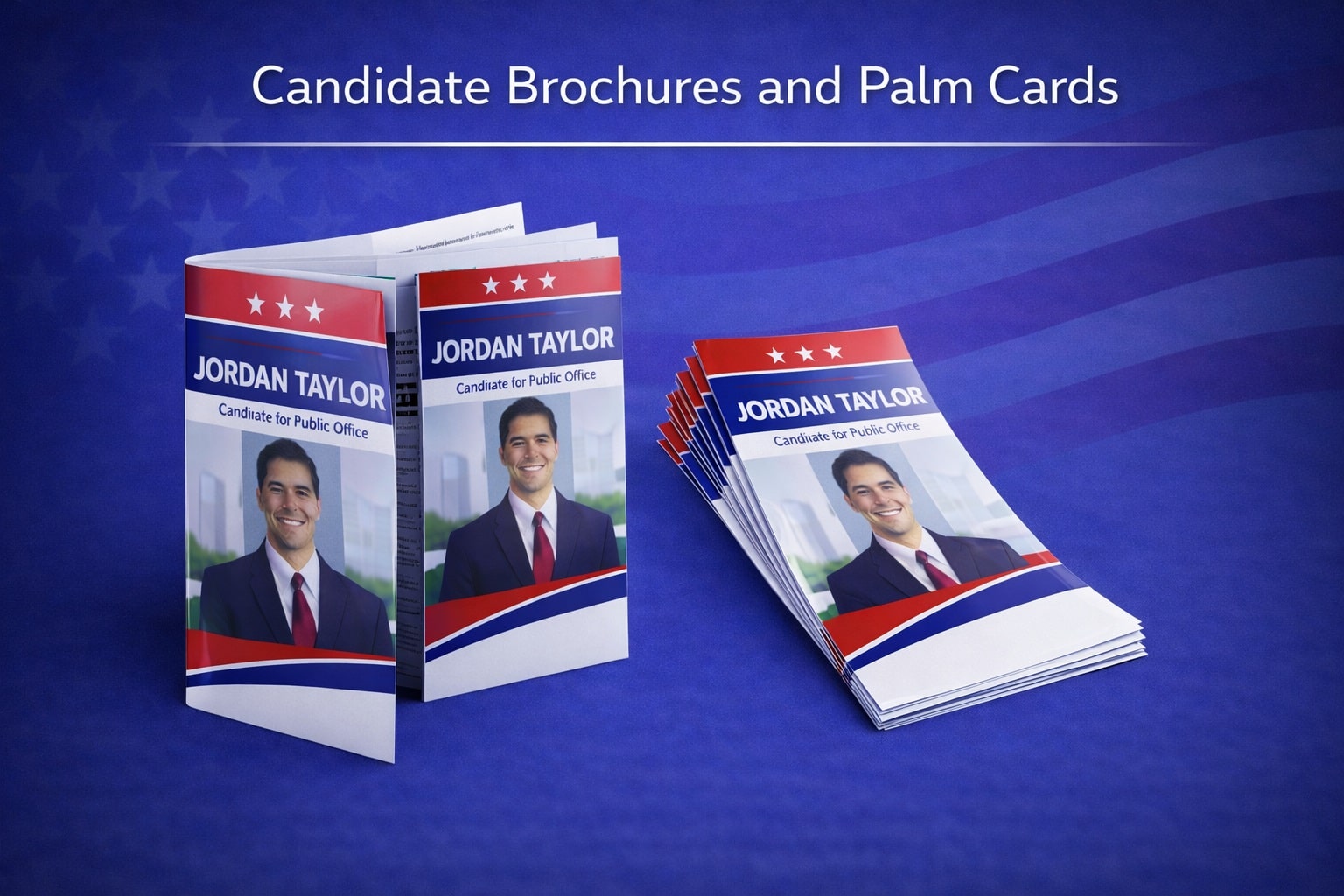
The Role of Brochures and Palm Cards in Campaign Strategy
Campaigns rely on political brochures because they offer balance. They are more substantial than flyers but more flexible than direct mail. They can be handed out, mailed, displayed at events, or left behind during canvassing.
Brochures are especially effective when campaigns need to:
-
Introduce a candidate in detail
-
Explain experience, qualifications, and priorities
-
Address voter concerns clearly
-
Present endorsements and community support
-
Reinforce credibility and professionalism
Palm cards serve a complementary role. They are compact, easy to carry, and ideal for quick distribution. Campaign staff and volunteers often use palm cards during door knocking, meet-and-greet events, and polling place outreach where brevity matters.
Together, brochures and palm cards form a core part of political campaign printing strategies focused on clarity and voter confidence.
Common Uses for Candidate Brochures
Candidate brochures are typically multi-panel folded pieces that allow campaigns to organize information logically.
Many campaigns use brochures to present:
-
A short candidate biography
-
Background and professional experience
-
Key policy priorities
-
Community involvement
-
Endorsements and testimonials
-
Voting information and contact details
Because brochures allow for structure, campaigns can guide voters through information in a controlled way. This is especially important in competitive races where voters want more than a name and a slogan.
Brochures are often used at:
-
Campaign offices
-
Community events
-
Fundraisers
-
Town halls
-
Door-to-door canvassing
They are also frequently included in campaign mailers or handed out alongside flyers and palm cards.
How Palm Cards Support Campaign Outreach
Political palm cards are designed for speed and simplicity. They typically feature a candidate’s name, photo, office sought, and a short list of priorities or talking points.
Palm cards work well when:
-
Conversations are brief
-
Voters are on the move
-
Volunteers need something quick to leave behind
-
Campaigns want a lightweight handout
Despite their small size, palm cards can be highly effective. When designed well, they reinforce name recognition and provide a clear reminder of the candidate and election details.
Palm cards are often used near polling locations where permitted, at community gatherings, and during last-minute get out the vote efforts.
Design Considerations for Brochures and Palm Cards
Effective candidate brochure design focuses on organization and readability. Voters should be able to follow the content naturally without feeling overwhelmed.
Headings and subheadings help structure information. Bullet points improve scannability. White space prevents clutter and improves comprehension.
Photography plays an important role. Candidate photos should feel authentic, approachable, and professional. Overly staged or artificial images can reduce trust.
Color usage should align with campaign branding while maintaining readability. Consistent colors and fonts across brochures, palm cards, and other campaign materials reinforce recognition.
Paper Stock and Print Quality
Brochures and palm cards are often kept longer than flyers, which makes print quality especially important.
Heavier paper stocks convey seriousness and durability. A brochure that feels substantial signals professionalism and credibility. Palm cards benefit from thicker stocks that resist bending and wear.
Finish selection affects perception. Matte finishes can feel refined and understated. Satin finishes offer a balance between vibrancy and readability.
Clean folds, accurate trimming, and sharp printing are essential. Poor finishing can distract from the message and reflect negatively on the campaign.
Messaging Tone and Content Balance
Campaign brochures must strike a balance between information and persuasion. Voters want clarity, not overload.
Strong brochures focus on:
-
Clear priorities
-
Simple explanations
-
Honest tone
-
Logical flow
Palm cards require even more discipline. Limited space forces campaigns to identify the most important points and present them clearly.
Both formats should avoid excessive jargon or complex language. Plain, direct communication builds trust.
Compliance and Disclosure Requirements
Like all election printing, candidate brochures and palm cards must include required disclosures. These typically identify who paid for the material and whether it was authorized by the candidate or committee.
Disclosures must be readable and properly placed without overwhelming the design.
Working with experienced political printers helps campaigns maintain compliance while preserving clean layout and readability.
Scaling Brochure and Palm Card Printing
Campaigns often print brochures and palm cards in phases. Early versions may focus on introduction, while later versions emphasize voting information or updated messaging.
This phased approach allows campaigns to:
-
Adjust content as priorities evolve
-
Replace materials as supplies run low
-
Maintain consistency across the election cycle
Efficient production and fast turnaround are especially important as election day approaches.
Why Brochures and Palm Cards Still Matter
Despite changes in media consumption, candidate brochures and palm cards remain effective because they provide clarity and permanence.
They support conversations, reinforce messaging, and give voters something tangible to reference later.
For campaigns focused on trust, understanding, and voter confidence, brochures and palm cards continue to be essential tools.
Candidate Brochures and Palm Cards FAQ
What is the difference between a brochure and a palm card?
A brochure is typically a folded piece that provides detailed information, while a palm card is a smaller handout designed for quick distribution and easy carrying.
When should campaigns use candidate brochures?
Brochures are most effective when campaigns need to explain a candidate’s background, priorities, and qualifications in more detail.
Are palm cards still useful in campaigns?
Yes. Palm cards are widely used during canvassing, events, and get out the vote efforts because they are quick and easy to distribute.
Do candidate brochures require disclaimers?
Yes. Most brochures and palm cards must include disclosures identifying who paid for the material and whether it was authorized by a candidate or committee.
What paper stock works best for brochures and palm cards?
Heavier paper stocks are commonly used to convey durability and professionalism. The best choice depends on design and distribution method.
Can campaigns update brochures during the election?
Yes. Many campaigns print updated versions as messaging evolves or voting information changes.