


Healthcare & Medical Industry Printing Services
Healthcare and medical organizations rely on printed materials to support patient care, compliance, internal operations, and communication across facilities. While digital systems are widely used, print remains a critical component of healthcare infrastructure due to regulatory requirements, accessibility needs, redundancy planning, and the need for clear, standardized documentation.
Hospitals, clinics, medical groups, laboratories, outpatient centers, and healthcare networks operate in highly regulated environments. Printed materials must be accurate, consistent, and produced in a way that supports compliance with healthcare standards and internal protocols. These materials are rarely created once and forgotten. They are part of ongoing print programs that must be maintained, updated, and reproduced reliably over time.
In healthcare environments, printing is not primarily a marketing function. It is an operational necessity. Items such as patient forms, medical labels, instructional materials, and clinical documentation support workflows that directly affect patient safety and care delivery. Errors, outdated materials, or inconsistencies can create confusion, slow processes, or introduce compliance risks.
For these reasons, healthcare printing is typically managed through structured production workflows rather than ad hoc ordering. Organizations look for dependable print partners who understand the importance of accuracy, consistency, and controlled execution.
Centralized Print Management
Many enterprise organizations rely on printed materials across multiple departments, each with unique requirements and compliance considerations. Without a coordinated approach, managing these materials can become fragmented and difficult to scale.
CenTex Printing supports organizations through structured print programs designed to manage ongoing production needs across multiple formats. By centralizing coordination and oversight, we help ensure consistency, accuracy, and accountability throughout the print lifecycle.
This program-based approach allows organizations to maintain reliable standards while simplifying internal processes.
The Role of Print in Healthcare Operations
Printed materials continue to play an essential role in healthcare because many processes require physical documentation that is easy to reference, distribute, and retain. Print is often used where clarity, accessibility, and reliability are critical, especially in clinical and patient-facing environments.
Healthcare organizations rely on printed documents for patient intake, consent, treatment instructions, medication guidance, and internal communication. These materials must be readable, clearly formatted, and consistent across departments and locations.
Many healthcare systems operate across multiple facilities. Centralized print programs ensure that all locations use the same approved documents, reducing variation and maintaining compliance. This is especially important when regulations change or procedures are updated and materials must be revised quickly.
Print also serves as an important backup and accessibility tool. In environments where digital access may be limited or interrupted, printed materials provide continuity and support safe operations.
Common Printing Needs in Healthcare and Medical Settings
Healthcare printing includes a wide range of materials designed to support both clinical and administrative functions. These materials are often produced in large quantities and reordered regularly.
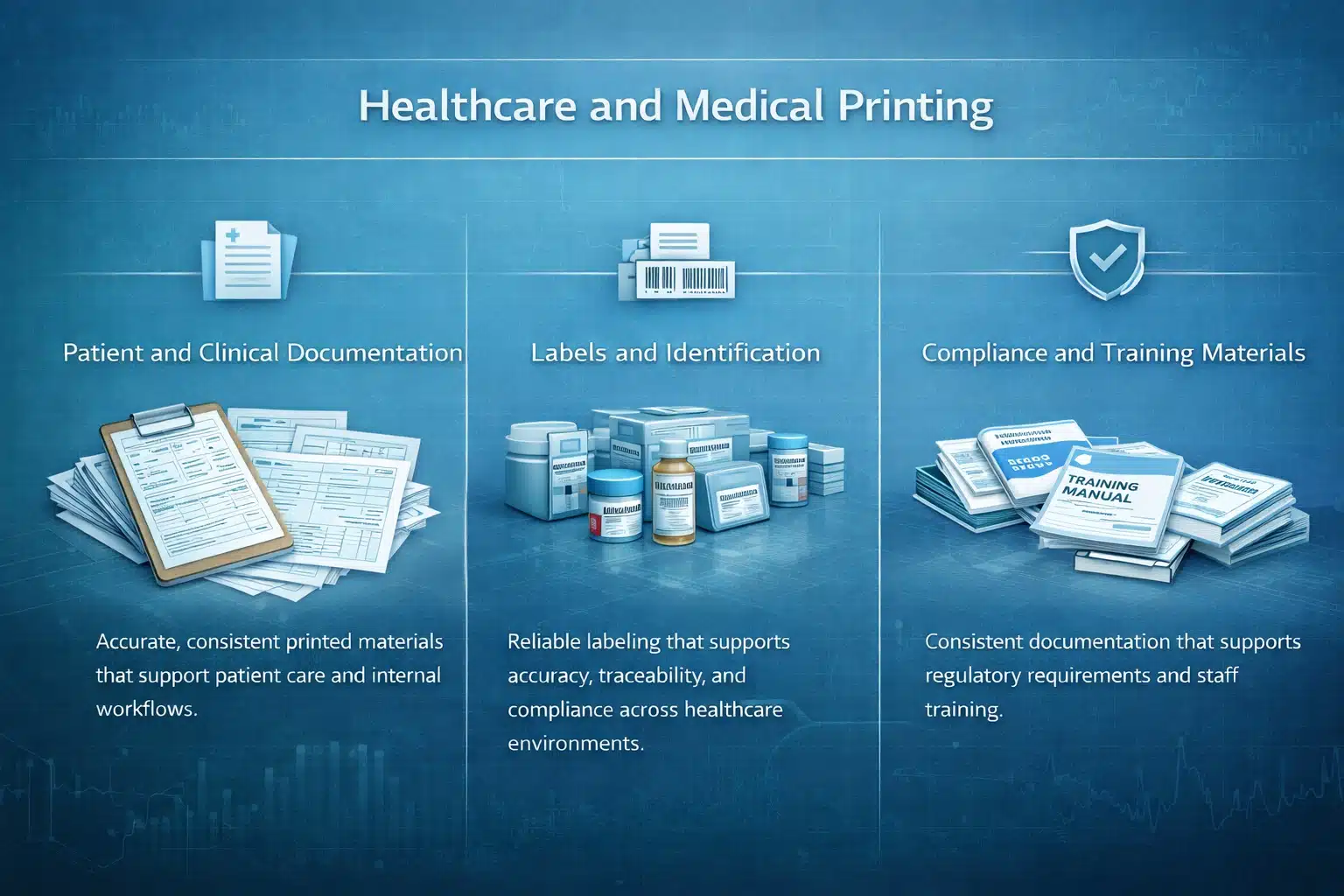
Patient-facing documents are among the most common. These include patient intake forms, consent documents, instructional brochures, discharge paperwork, and informational handouts. These materials must be easy to understand and formatted for clarity to support informed decision making.
Medical labeling is another critical area. Medical labels, specimen labels, equipment labels, and identification materials help ensure accurate tracking and reduce the risk of errors. These labels often require specific sizes, adhesives, and durability to perform correctly in healthcare environments.
Operational and administrative documents support internal workflows. NCR forms, internal documentation, training materials, and compliance records help healthcare organizations manage processes efficiently while maintaining accountability.
Educational materials are also widely used. Training manuals, procedure guides, and instructional booklets support staff onboarding, continuing education, and policy adherence across departments.
Accuracy, Compliance, and Consistency Requirements
Healthcare printing requires a strong emphasis on accuracy and consistency. Printed materials must reflect current policies, procedures, and regulatory requirements. Outdated or inconsistent documents can create confusion and compliance issues.
Many healthcare documents must follow specific formatting standards. This includes layout structure, font choices, spacing, and language consistency to ensure documents are usable and compliant. In some cases, materials must align with accreditation or regulatory guidelines.
Consistency across locations is especially important for healthcare networks. Centralized print management helps ensure that approved materials are distributed uniformly and that unauthorized changes are avoided.
While not all healthcare materials require secure handling, some documents involve sensitive information or controlled usage. Responsible production and distribution practices help support privacy and compliance expectations.
Centralized Print Programs for Healthcare Organizations
Healthcare organizations often benefit from centralized print programs that support multiple departments and facilities. Rather than allowing individual locations to create or source materials independently, centralized programs provide structure and oversight.
These programs typically include standardized templates, approved content, and defined reorder processes. This approach simplifies procurement while supporting compliance and version control.
Centralized print programs also make it easier to implement updates. When procedures or regulations change, revised materials can be produced and distributed efficiently across the organization.
Scalable production capabilities are essential in healthcare environments where demand can fluctuate. Reliable print partners help ensure materials are available when needed without disruptions.
In-House and Off-Site Production Considerations
Healthcare print programs often involve a combination of in-house production and off-site manufacturing. Some materials may be produced internally for quick turnaround, while others require specialized equipment or higher-volume production.
A managed production approach allows healthcare organizations to coordinate printing across different methods while maintaining quality and consistency. This model provides flexibility without sacrificing oversight.
For healthcare buyers, the primary concerns are accuracy, reliability, and compliance support. The production method is less important than ensuring materials meet specifications and are delivered on time.
Print as a Support System for Patient Care
In healthcare environments, print functions as part of the operational support system rather than a promotional channel. Well-designed printed materials contribute to clarity, safety, and trust.
Patients often rely on printed instructions and documentation to understand care plans and next steps. Clear, professionally produced materials help reduce confusion and improve patient experience.
When healthcare printing is managed correctly, it operates quietly and reliably. When it fails, the consequences can affect both operations and patient outcomes. This is why structured print programs and experienced production partners are essential in medical environments.
Frequently Asked Questions
What types of healthcare organizations require professional printing?
Hospitals, clinics, medical groups, laboratories, outpatient centers, and healthcare networks commonly rely on professional printing to support operations and compliance.
Are printed materials still necessary in modern healthcare systems?
Yes. Many healthcare processes require printed documentation for patient communication, regulatory compliance, accessibility, and operational reliability.
Can healthcare print programs support multiple facilities?
Centralized print programs are designed to support healthcare organizations with multiple locations while maintaining consistency and control.
Do healthcare print materials require special formatting or standards?
Many healthcare documents must follow specific formatting, language, and layout requirements to ensure clarity and compliance.
Can printing be managed across internal and external production facilities?
Healthcare organizations often use hybrid production models that combine in-house printing with specialized off-site manufacturing.

Healthcare & Medical Industry