




Banking & Financial Industry Printing Services
The banking and financial services industry depends on printed materials to support transactions, compliance, internal controls, and customer communication. Even as digital platforms expand, print continues to play a critical role in financial operations because of regulatory requirements, security considerations, auditability, and customer trust.
Banks, credit unions, payment processors, and financial service organizations operate in highly controlled environments. Printed materials must be accurate, consistent, and produced at scale. These materials are rarely one-time projects. They are part of structured print programs that must be repeatable, reliable, and managed over long periods of time.
For financial institutions, printing is not primarily about promotion. It is about maintaining operational continuity. Documents such as money orders, checks, deposit slips, and secure financial forms support the daily movement of funds and information. Errors or inconsistencies in printed financial documents can lead to compliance issues, processing delays, or loss of customer confidence.
Because of these risks, financial printing is typically centralized and handled through experienced production partners who understand the operational and regulatory realities of the industry.
Simplified Print Procurement
Purchasing teams in regulated and enterprise environments are often responsible for sourcing a wide range of printed materials, each with its own requirements, vendors, and timelines. Coordinating multiple print suppliers can increase risk, slow response times, and complicate internal workflows.
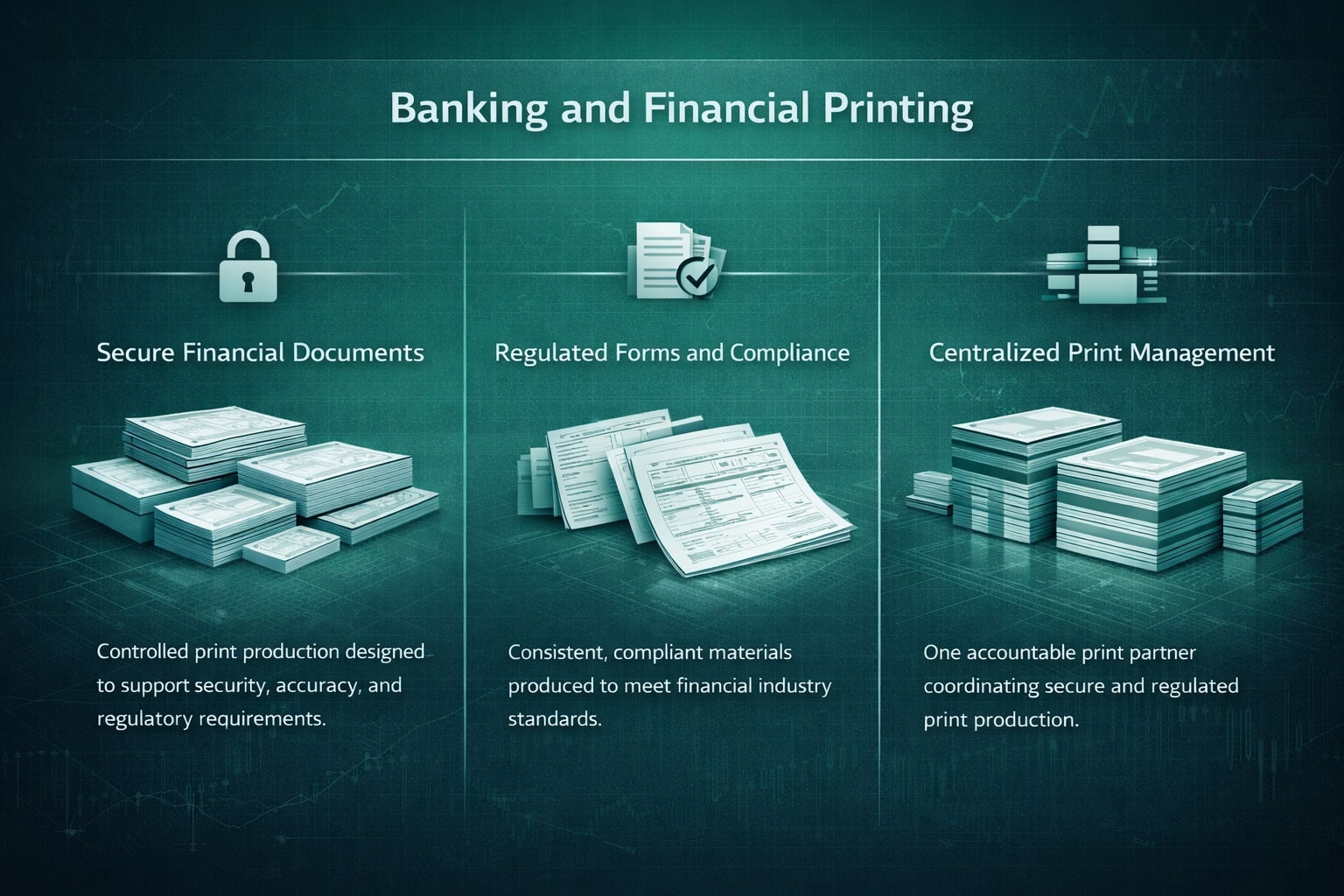
CenTex Printing acts as a centralized print partner, managing multiple print formats and production requirements through one point of contact. This model helps organizations streamline purchasing, maintain consistency, and ensure accountability across ongoing print needs.
By consolidating print procurement, organizations gain better control without sacrificing flexibility or compliance.
The Role of Print in Financial Operations
Print remains embedded in financial workflows because many processes require physical documentation that can be verified, retained, and audited. Printed materials often serve as the official or legally recognized record, even when digital versions exist.
Financial organizations rely on printed documents for account onboarding, transaction processing, internal approvals, dispute resolution, and regulatory reporting. These materials must follow precise layouts, field placement, and formatting standards to ensure compatibility with scanning systems, processing equipment, and internal controls.
Many financial organizations operate across multiple branches or service centers. Centralized printing ensures that every location uses the same approved materials, reducing risk and maintaining consistency. This is especially important when regulations change and documents must be updated quickly across an entire organization.
Common Printing Needs in the Banking and Financial Industry
Printing for financial institutions covers a wide range of operational and customer-facing materials. These materials are typically produced in high volumes and reordered on a recurring basis.
Transactional documents are among the most critical. Items such as money orders, financial instruments, and controlled documents often require strict formatting, sequential numbering, and compatibility with automated processing systems. These documents must be produced accurately and consistently to avoid processing errors.
Operational forms are also essential. Financial institutions commonly use NCR forms, pin-fed forms, and structured internal documents to support workflows, approvals, and record keeping. These materials are designed for efficiency and accuracy in high-volume environments.
Customer documentation plays a key role in transparency and compliance. Account agreements, disclosures, instructional inserts, and informational materials must be clear, readable, and consistent across all locations. These documents help ensure customers understand financial products and services while meeting legal requirements.
Marketing and informational print materials continue to support branch-level communication. Brochures, rate sheets, statement inserts, and branch signage provide tangible communication tools that many customers still trust and rely on.
Accuracy, Security, and Compliance Considerations
Financial printing demands a high level of accuracy. Even small errors in layout, numbering, or content can create significant operational or regulatory problems. For this reason, financial print programs emphasize precision and repeatability.
Many financial documents must follow predefined templates and approved language. This includes exact placement of fields, consistent spacing, and standardized formatting to ensure documents function correctly within processing systems.
Security is another major consideration. Certain financial documents require controlled handling and limited access during production and distribution. While not every printed item requires enhanced security features, financial organizations must ensure sensitive materials are produced responsibly and tracked appropriately.
Consistency across time and location is equally important. Financial institutions often operate under strict brand and compliance guidelines. Centralized print management helps ensure outdated or unauthorized materials are not introduced into circulation.

Centralized Print Programs for Multi-Location Financial Organizations
Large financial organizations benefit from centralized print programs that support multiple branches, departments, and service centers. Rather than allowing individual locations to manage print independently, centralized programs maintain control and consistency.
These programs typically include standardized templates, approved layouts, and defined reorder processes. This allows financial organizations to manage compliance while simplifying procurement and inventory management.
Centralized print programs also support version control. When regulations or internal policies change, updated materials can be deployed consistently across all locations without confusion or delay.
In-House and Off-Site Production Models
Financial print programs often use a combination of in-house production and off-site manufacturing. Some materials may be produced internally for speed or flexibility, while others require specialized equipment or large-scale production capabilities.
A managed production model allows financial organizations to work with a single point of contact while accessing multiple production methods. This approach provides scalability without sacrificing accountability or quality control.
For financial buyers, the most important factors are reliability, accuracy, and consistency. The specific production location is secondary to ensuring materials meet specifications and arrive on schedule.
Print as Infrastructure Within Financial Systems
In financial environments, print functions as part of the operational infrastructure rather than a marketing channel. Well-produced printed materials contribute to stability, clarity, and trust.
Customers often associate physical financial documents with legitimacy and permanence. Clear, professionally produced print helps reduce confusion and supports informed decision making.
When financial printing is managed correctly, it operates quietly in the background. When it fails, the impact can be immediate and disruptive. This is why structured print programs and experienced production partners are essential within the banking and financial industry.
Frequently Asked Questions
What types of financial organizations typically require professional printing?
Banks, credit unions, payment processors, insurance firms, and multi-branch financial service providers commonly require professional printing to support operations and compliance.
Are printed financial documents still necessary today?
Yes. Many financial processes still require printed documentation for legal, regulatory, operational, or customer assurance purposes.
Can financial print programs support multiple branch locations?
Centralized print programs are designed specifically to support organizations with multiple locations while maintaining consistency and control.
Do financial print projects require special handling?
Some financial documents require controlled production, precise formatting, and secure handling depending on their purpose and regulatory requirements.
Can printing be managed across both internal and external production facilities?
Many financial organizations use hybrid production models that combine in-house printing with specialized off-site manufacturing.