



Political Campaign Mailer Printing for Elections and Voter Outreach
Political campaign mailer printing plays a central role in how campaigns communicate with voters inside their homes. Unlike signage or field materials that depend on visibility and timing, mailers create a focused, deliberate interaction. A voter opens their mailbox and encounters a campaign message without distraction, allowing space for explanation, persuasion, and reinforcement.
Campaign mailers are where messaging becomes intentional. They allow campaigns to introduce candidates, explain positions, highlight contrasts, and guide voter behavior with clarity. For many elections, especially competitive or issue-driven races, election mailer printing becomes the backbone of voter education and persuasion.
From local school board contests to statewide initiatives, political mailers remain one of the most reliable and controllable tools in political campaign printing.
Why Campaigns Depend on Mailer Printing
Campaign mailers succeed because they are purposeful. They are sent to specific households, delivered at strategic moments, and designed to align with broader campaign activity. Unlike digital ads that compete for attention, printed mail arrives as a tangible message that voters physically handle.
Political mailers allow campaigns to shape narrative and tone. A well-designed piece can feel informative, authoritative, or personal depending on the objective. Mailers also reinforce legitimacy. Voters tend to associate professionally printed mail with seriousness and organization, especially in contrast to lower-quality outreach.
Campaigns frequently rely on mailers to:
-
Introduce a candidate or issue
-
Clarify positions and priorities
-
Draw contrasts with opponents
-
Reinforce name recognition
-
Encourage turnout during early voting and election day
Common Types of Political Campaign Mailers
Political campaign mailer printing includes several formats, each serving a distinct role within an election strategy.
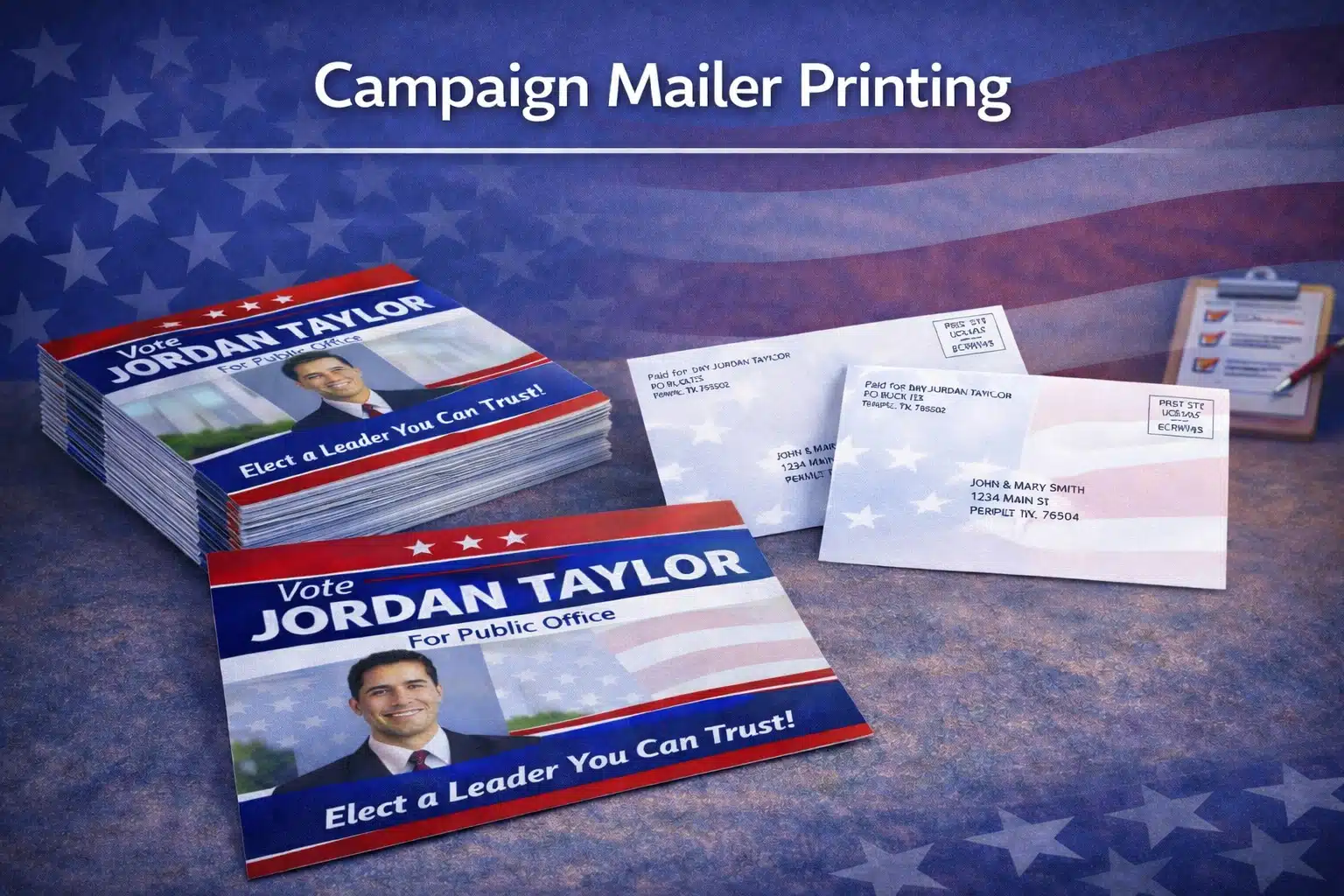
Postcards are widely used for visibility and repetition. They are easy to scan, cost effective, and ideal for reminders, endorsements, and voting logistics.
Folded self-mailers provide more space for storytelling and issue explanation. Campaigns often use them to outline policy positions, share endorsements, or present biographical information.
Letters are used when campaigns want a more personal tone. These pieces often feel conversational and are commonly paired with envelopes to increase open rates.
Brochures and multi-panel mailers are especially valuable for ballot initiatives and issue-based campaigns, where voters need clear explanations of complex topics.
Each format supports different messaging goals, and most campaigns deploy multiple types over the course of an election.
Messaging Strategy and Timing
Successful campaign mailer printing depends heavily on timing. Rarely does a campaign rely on a single mail piece. Instead, mailers are deployed in stages that mirror the voter decision process.
Early mailers focus on awareness and introduction. These establish a candidate’s name, background, and motivation. Mid-cycle mailers emphasize persuasion and issue alignment, helping voters understand where a candidate stands. Late-stage mailers prioritize turnout and urgency, often highlighting voting dates, locations, and deadlines.
Mailers are most effective when coordinated with other outreach efforts. Door hangers, phone calls, digital ads, and text messaging all reinforce the same message, increasing recall and trust.
Design and Readability Considerations
Effective political mailer design prioritizes clarity. Voters often decide within seconds whether to continue reading, so hierarchy and layout matter.
Strong headlines communicate the core message immediately. Subheadings guide the reader through the content. Body text should be concise, well spaced, and easy to scan.
Images should feel professional and authentic. Candidate photos should appear natural and approachable. Visual elements should support the message rather than overwhelm it.
Consistency across mailers and other campaign materials is essential. When campaign branding remains uniform, voters quickly associate messages with the candidate or issue.
Print Quality and Production Consistency
Print quality directly affects credibility. Poorly printed campaign mailers can undermine trust and weaken messaging, regardless of content.
High-quality printing ensures:
-
Accurate color reproduction
-
Sharp images and text
-
Consistent trimming and folding
-
Durable pieces that withstand handling and delivery
Campaigns that produce mailers in multiple waves benefit from consistent production standards so each piece feels like part of a unified effort.
Compliance and Disclosure Requirements
Political campaign mailers are subject to disclosure requirements that vary by jurisdiction. These typically include identifying who paid for the piece and whether it was authorized by a candidate or committee.
Disclosures must be clearly legible and properly placed. Small or unclear disclaimers can create compliance issues and public scrutiny.
Working with experienced election printing providers helps campaigns avoid errors and maintain consistency across all printed materials.
Targeting and Voter Segmentation
One of the strongest advantages of campaign mailer printing is targeting. Mailers can be tailored by district, precinct, or voter demographic, allowing campaigns to deliver relevant messages to specific audiences.
Different versions of a mailer may emphasize different issues depending on voter priorities. This targeted approach improves engagement and reduces wasted impressions.
Scaling Mailer Printing for Campaigns
Campaigns often need to scale mailer printing quickly. Quantities may range from a few thousand pieces for local races to hundreds of thousands for larger elections.
Phased printing allows campaigns to adjust messaging, quantities, and timing as conditions change. This flexibility is especially important during fast-moving election cycles.
Reliable political printing services support rapid turnaround without sacrificing quality or consistency.
The Enduring Role of Campaign Mailers
Despite the growth of digital communication, political campaign mailers remain a cornerstone of voter outreach. They offer control, credibility, and clarity that few other channels can match.
For campaigns that need to inform, persuade, and mobilize voters, campaign mailer printing continues to deliver measurable impact election after election.
Political Campaign Mailer Printing FAQ
What is a political campaign mailer?
A political campaign mailer is a printed piece sent directly to voters through the mail. Common formats include postcards, folded self-mailers, letters, and brochures used for voter education and persuasion.
When should campaigns send mailers?
Mailers are typically sent throughout the campaign. Early mailers introduce the candidate, mid-cycle mailers focus on issues, and late mailers encourage turnout and provide voting information.
Do political mailers require disclaimers?
Yes. Most election mailers must include disclosures identifying who paid for the piece and whether it was authorized by a candidate or committee.
What type of mailer works best for campaigns?
The best format depends on the message. Postcards work well for reminders, while folded mailers and letters allow for more detailed communication.
Can campaigns target different voters with different mailers?
Yes. Campaigns frequently print multiple versions of mailers tailored to specific districts or voter groups.
Are political campaign mailers still effective?
Yes. Mailers remain one of the most effective tools for voter education, persuasion, and turnout, especially when combined with other outreach efforts.