




Oil and Gas Industry Printing Services
The oil and gas industry relies heavily on printed materials to support safety, compliance, operations, and asset identification across complex and often hazardous environments. While digital systems play an important role in modern energy operations, print remains essential due to durability requirements, regulatory standards, and the need for clear, visible communication in the field.
Upstream, midstream, and downstream operations all depend on printed materials that can withstand harsh conditions. Refineries, drilling sites, pipelines, processing facilities, and distribution terminals use printed signage, labels, and documentation to communicate critical information where clarity and reliability are non-negotiable.
Printing in oil and gas environments is not marketing-driven. It is operational and safety-driven. Items such as industrial safety signage, pipe labels, equipment decals, and compliance documentation are required to meet industry regulations and internal safety protocols. These materials must be accurate, consistent, and produced at scale.
Because oil and gas operations are distributed across multiple sites and jurisdictions, printing is typically managed through centralized programs that ensure consistency and compliance across the entire organization.
Reducing Vendor Complexity
Managing multiple print vendors for different materials can increase administrative effort and introduce inconsistencies across departments and locations. For purchasing teams, this often results in additional coordination, oversight, and risk.
CenTex Printing helps organizations reduce vendor complexity by supporting a wide range of operational print needs under one managed relationship. We coordinate production requirements and maintain consistent standards so internal teams can work with fewer vendors without sacrificing reliability.
This approach supports clearer communication, improved control, and more efficient procurement workflows.
The Role of Print in Oil and Gas Operations
Printed materials play a critical role in communicating safety information and operational guidance throughout oil and gas facilities. Many environments require visual communication that remains readable despite exposure to heat, chemicals, moisture, and outdoor conditions.
Print is used extensively for hazard identification, equipment labeling, process flow communication, and regulatory notices. These materials support safe operations by ensuring workers can quickly identify risks, understand procedures, and follow established protocols.
Oil and gas organizations often operate across large geographic areas. Centralized print programs help ensure that signage, labels, and documentation are consistent across all sites, reducing confusion and supporting compliance.
Printed materials also serve as a durable backup in environments where digital access may be limited or unreliable. In high-risk environments, redundancy is essential, and print provides a reliable layer of communication.
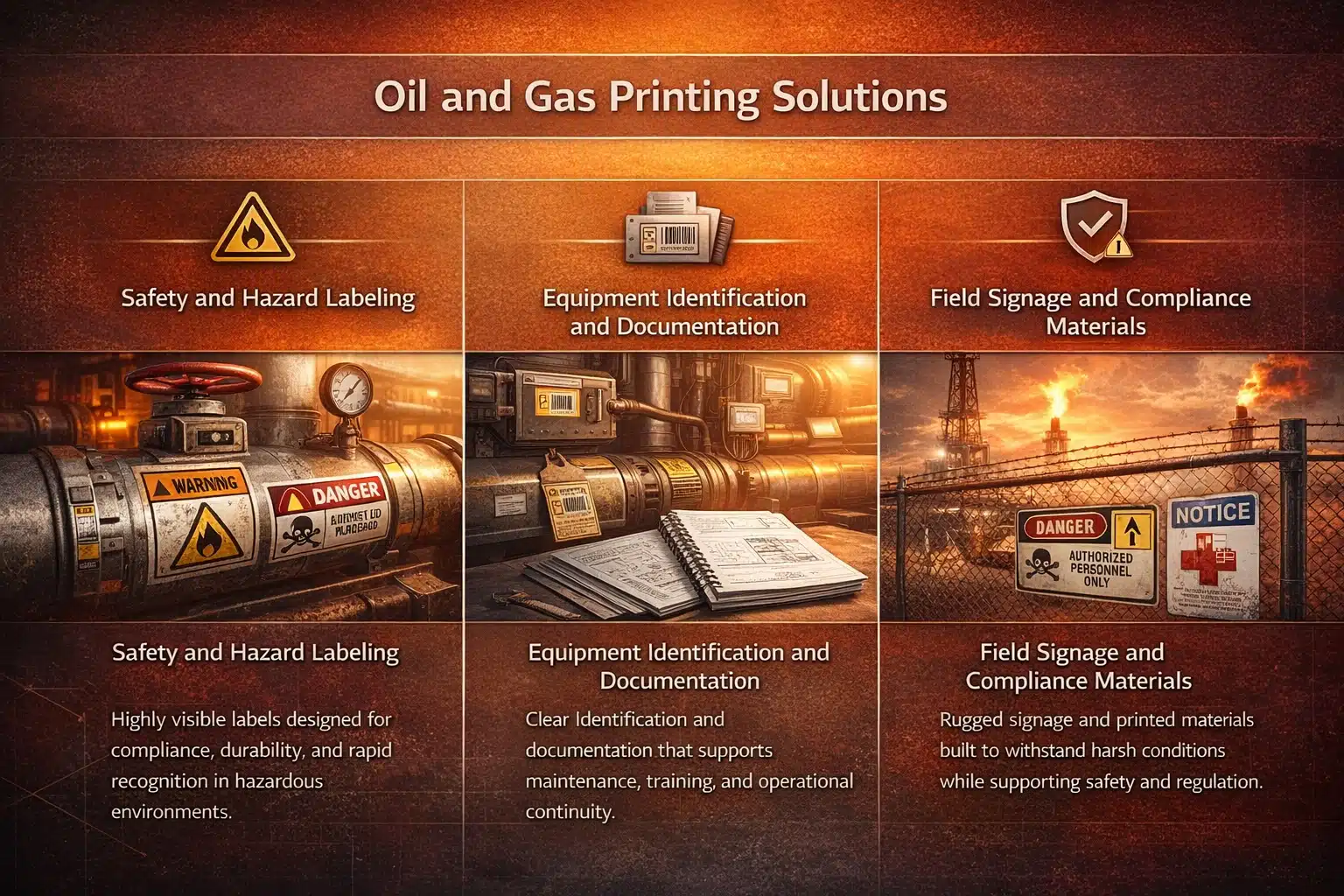
Common Printing Needs in the Oil and Gas Industry
Oil and gas printing includes a wide range of materials designed for safety, identification, and operational support. These materials are often produced in high volumes and must meet specific durability and visibility requirements.
Safety and warning signage is among the most critical categories. Industrial warning signs, hazard communication signage, and regulatory notices are used throughout facilities to communicate risks and required precautions. These signs must remain legible in demanding conditions.
Labeling and identification materials are also essential. Pipe labels, valve markers, equipment decals, and asset identification labels help workers quickly identify systems, contents, and flow direction. These labels often require weather-resistant materials and adhesives suitable for industrial surfaces.
Operational documentation supports internal workflows. Procedure manuals, inspection checklists, compliance records, and training materials help ensure consistent operations and accountability across sites.
Instructional and reference materials are commonly used for onboarding, safety training, and ongoing education. Printed manuals and guides provide a reliable reference in environments where digital devices may not be practical.
Safety, Compliance, and Durability Requirements
Printing for oil and gas applications must meet strict safety and compliance standards. Many printed materials are governed by industry regulations and internal policies designed to protect workers and the environment.
Durability is a key requirement. Materials must withstand exposure to sunlight, chemicals, temperature fluctuations, and physical wear. This applies to signage, labels, and decals used both indoors and outdoors.
Accuracy and consistency are equally important. Incorrect labeling or outdated signage can create safety risks and compliance violations. Centralized control over print production helps ensure that approved materials are used consistently across all locations.
Because regulations and standards can change, print programs must support updates and replacements without disrupting operations. Reliable production and distribution processes are essential.
Centralized Print Programs for Oil and Gas Organizations
Oil and gas companies often rely on centralized print programs to manage materials across multiple facilities and regions. These programs provide oversight and consistency while simplifying procurement and inventory management.
Centralized print programs typically include standardized templates, approved designs, and defined production specifications. This approach helps ensure that all materials meet safety and compliance requirements.
Centralized management also makes it easier to deploy updates. When regulations change or procedures are revised, updated materials can be produced and distributed efficiently across all sites.
Scalability is critical in this industry. Print programs must be able to support large volumes and respond quickly to operational demands.
In-House and Off-Site Production Considerations
Oil and gas print programs often involve both in-house production and off-site manufacturing. Some materials may be produced internally for rapid deployment, while others require specialized equipment or materials best handled by dedicated production facilities.
A managed production approach allows organizations to coordinate multiple production methods while maintaining quality and consistency. This provides flexibility without sacrificing control.
For oil and gas buyers, reliability and compliance support are often more important than where the printing occurs. The priority is ensuring materials meet specifications and are delivered when needed.
Print as a Safety and Operational Infrastructure
In oil and gas environments, print functions as part of the safety and operational infrastructure. Clear, durable printed materials help protect workers, support compliance, and maintain efficient operations.
Well-designed signage and labeling reduce the likelihood of errors and accidents. Printed documentation supports training, inspections, and audits.
When printing is managed correctly, it supports operations quietly and reliably. When it fails, the consequences can be serious. This is why structured print programs and experienced production partners are essential in the oil and gas industry.
Frequently Asked Questions
What types of oil and gas organizations require professional printing?
Upstream, midstream, and downstream operators including drilling companies, pipeline operators, refineries, processing facilities, and energy service providers commonly rely on professional printing.
Are printed materials still necessary in oil and gas operations?
Yes. Printed signage, labels, and documentation remain essential for safety, compliance, and operational communication.
Can print programs support multiple sites and facilities?
Centralized print programs are designed to support organizations with multiple locations while maintaining consistency and compliance.
Do oil and gas print materials require special durability?
Many materials must be weather-resistant, chemical-resistant, and suitable for harsh industrial environments.
Can printing be managed across internal and external production facilities?
Oil and gas organizations often use hybrid production models that combine in-house printing with specialized off-site manufacturing.