




Printing Services
Quick Reference Guides: A Critical Safety Addition Often Overlooked
Walk through almost any manufacturing facility, warehouse, fleet shop, or industrial plant, and you will see a common challenge.
Information is everywhere.
Procedures exist for everything from safety requirements to machine operation to maintenance schedules. But when someone actually needs that information, it is often buried inside a binder, a training manual, or a digital system that takes several minutes to search.
In environments where time matters and mistakes can be expensive or dangerous, people do not have time to scroll through a document or dig through a manual.
That is where quick reference guides come in.
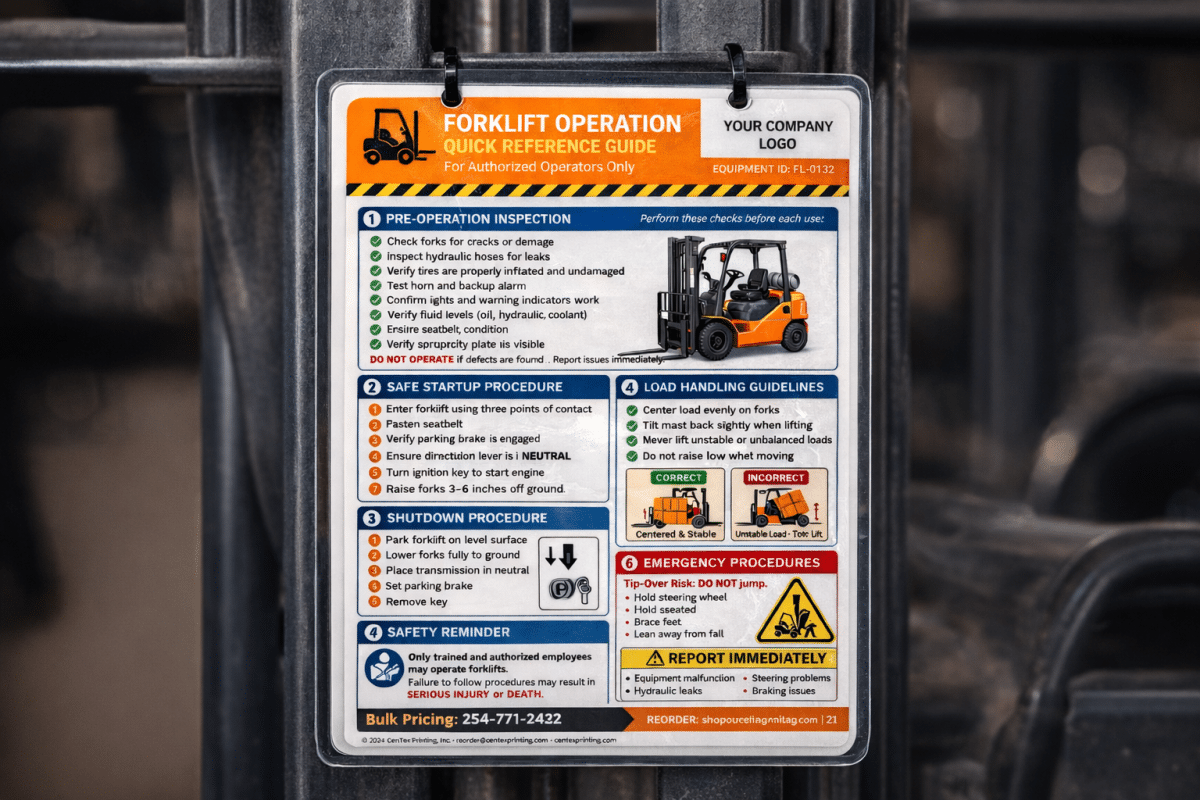
A well designed printed quick reference guide gives employees the exact information they need at the exact moment they need it. It sits on a wall, inside a vehicle, attached to a machine, or clipped to a clipboard. Instead of searching for information, the answer is already in front of them.
For industrial environments, fleet operations, and manufacturing facilities, these guides are one of the simplest tools available to improve safety, efficiency, and consistency.
And despite the push toward digital tools, printed quick reference guides continue to be one of the most effective solutions.
What Is a Quick Reference Guide?
A quick reference guide is exactly what it sounds like.
It is a condensed, simplified document that highlights key procedures, safety reminders, or operational steps in a format that can be reviewed in seconds.
Instead of a 50 page training manual, a quick reference sheet focuses on the most important information someone needs to perform a task correctly.
Common examples include:
• Equipment startup procedures
• Safety checklists
• Maintenance intervals
• Emergency procedures
• Vehicle inspection lists
• Troubleshooting steps
• Calibration instructions
• Chemical handling instructions
• Lockout and tagout procedures
These guides are often printed as laminated reference cards, durable job aids, or heavy duty printed sheets that can survive tough environments.
When designed properly, a quick reference guide becomes part of the workflow rather than just another document.
Why Printed Reference Guides Still Work Better Than Digital
Digital systems are useful. Many organizations store documentation in internal portals, training systems, or shared drives.
But there is a simple reality in industrial environments.
When someone is working on a piece of equipment, driving a fleet vehicle, or standing on a shop floor, they are not always able to stop and search a digital system.
A printed quick reference guide removes that barrier.
The information is visible immediately.
Here are a few reasons printed job aids remain so effective.
Instant Access
When a guide is physically located where work happens, the answer is always available.
A machine operation reference guide attached to equipment means the operator can review startup procedures in seconds.
A fleet inspection checklist mounted inside a vehicle ensures drivers can quickly confirm safety steps before starting a route.
There is no login. No search bar. No waiting.
Just immediate information.
Reduced Errors
Even experienced employees occasionally forget a step in a process.
That is normal.
In environments where procedures matter, a printed quick reference sheet acts as a simple safeguard against missed steps.
For example:
A maintenance checklist guide can prevent skipped inspection steps.
A chemical handling quick guide can remind workers about safety procedures.
A vehicle pre trip inspection card ensures drivers verify critical safety items.
A forklift reference guide can be a great asset towards improving safety.
These guides are not replacements for training. They reinforce training in the real world.
Faster Training for New Employees
Training new employees takes time.
In many manufacturing facilities and fleet operations, supervisors rely on experienced employees to help train new hires. Quick guides make this process easier.
A printed training reference card allows new employees to review procedures independently without needing constant supervision.
Instead of asking the same questions repeatedly, they can simply glance at the guide.
Over time, these small tools can dramatically improve training efficiency.
Ideal for Harsh Work Environments
Industrial workplaces are not always friendly to paper.
Oil, dust, moisture, heat, and chemicals can destroy normal printed documents quickly.
That is why most industrial quick reference guides are printed using durable printing methods, such as:
• Laminated reference cards
• synthetic waterproof materials
• heavy duty laminated sheets
• UV resistant printed guides
These materials allow guides to remain usable for years even in difficult conditions.
Where Quick Reference Guides Are Most Useful
The versatility of printed quick reference guides means they can be used almost anywhere.
Here are some of the most common environments where organizations benefit from them.
Manufacturing Facilities
In a manufacturing environment, machines often require specific startup, shutdown, and maintenance procedures.
Posting machine operation quick reference guides near equipment helps operators follow the correct process every time.
These guides may include:
• Startup steps
• Safety reminders
• Emergency shutdown procedures
• Lubrication schedules
• Quality checkpoints
A simple laminated operation guide can prevent costly mistakes.
Fleet Operations
Fleet based businesses rely on drivers to follow procedures consistently.
This might include:
• vehicle inspection steps
• load safety checks
• accident reporting procedures
• maintenance schedules
• safety reminders
A fleet quick reference card placed inside every vehicle ensures drivers have instant access to these requirements.
This is particularly helpful for organizations with large fleets where consistency matters.
Maintenance Departments
Maintenance teams are responsible for a wide range of equipment.
Instead of carrying large manuals, technicians can reference maintenance quick guides for common procedures.
These may include:
• torque specifications
• calibration instructions
• troubleshooting charts
• maintenance intervals
A well designed laminated maintenance reference guide becomes a daily tool for technicians.
Warehousing and Logistics
Warehouses operate on speed and accuracy.
Quick reference guides can help workers remember procedures related to:
• equipment operation
• safety protocols
• shipping procedures
• pallet stacking guidelines
• forklift safety reminders
Because these environments are fast paced, visual reference sheets help reinforce proper practices.
Construction and Field Service
Workers in the field often operate in locations where internet access is unreliable.
In these cases, printed quick reference guides become even more valuable.
Field technicians can carry laminated reference cards that provide critical information such as:
• wiring diagrams
• installation procedures
• safety checklists
• equipment setup instructions
These guides travel with the employee and remain accessible at all times.
Designing an Effective Quick Reference Guide
Not all quick reference guides are created equal.
The goal is to make information easy to read quickly.
Here are several design principles that make guides more effective.
Keep Information Focused
A good quick reference guide does not try to include everything.
Instead, it focuses on the most important steps or reminders.
Short bullet points are often more effective than large blocks of text.
Use Clear Visual Hierarchy
Important information should stand out.
This can be achieved through:
• bold headings
• color coding
• icons or symbols
• numbered steps
These visual elements allow employees to scan information quickly.
Make It Durable
Because these guides are often used in demanding environments, durability matters.
Many organizations choose:
laminated quick reference guides
or
synthetic waterproof printed guides
These options allow the guides to resist tearing, moisture, and chemical exposure.
Place Guides Where Work Happens
The best quick reference guide is the one that is actually used.
Placement is critical.
Examples include:
• mounted near machines
• attached to equipment
• posted on safety boards
• inside vehicle cabins
• included in toolkits
When guides are visible, employees naturally reference them.
Custom Printed Quick Reference Guides for Your Organization
Every organization operates differently.
That is why most industrial quick reference guides are custom designed.
Instead of generic templates, companies often create guides tailored to their own equipment, procedures, and safety requirements.
Custom guides might include:
• company specific safety policies
• equipment specific procedures
• branded layouts with company logos
• color coded systems for different departments
At CenTex Printing, we work with organizations to produce custom printed quick reference guides designed specifically for their environment.
These guides can be produced in several formats depending on the intended use.
Common options include:
• laminated reference cards
• heavy duty laminated sheets
• folded quick reference booklets
• waterproof synthetic job aids
• durable shop floor reference posters
Because these guides are customized, they become a practical tool rather than just another document.
Why Many Businesses Are Bringing Back Printed Guides
Over the past decade, many companies attempted to move everything to digital systems.
What many discovered is that digital documentation does not always work well in environments where employees need immediate information.
As a result, many organizations are returning to printed quick reference materials as a complement to digital systems.
The combination works well.
Digital systems store full documentation.
Printed guides provide instant reminders for everyday tasks.
This hybrid approach improves both accessibility and reliability.
Small Tools That Create Big Improvements
One of the most interesting things about quick reference guides is how small they are compared to the impact they create.
A single laminated job aid might cost only a few dollars to produce.
But if it prevents a safety incident, avoids equipment damage, or reduces training time, the value becomes obvious.
Many organizations use these guides for years, constantly refining them as procedures improve.
Over time, they become an essential part of the workplace.
Final Thoughts
In fast paced environments like manufacturing facilities, fleet operations, and industrial workplaces, access to information matters.
When employees can quickly confirm procedures, safety improves and mistakes decrease.
That is why printed quick reference guides continue to be one of the most effective tools available.
They are simple, durable, and immediately accessible.
For many organizations, these guides quietly become one of the most useful resources on the shop floor.
If your organization relies on procedures, safety steps, or equipment instructions, a well designed custom printed quick reference guide can make a meaningful difference.