



Business Tips, Industrial & Enterprise Printing, Printing Services
The Hidden Cost of Managing Multiple Print Vendors
The Hidden Cost of Managing Multiple Print Vendors
In industrial and enterprise environments, printed materials are not optional. They are part of daily operations. Equipment labels, safety signage, compliance documentation, manuals, internal forms, secure financial documents, training materials, and standardized signage all play a role in keeping organizations running smoothly.
Yet for many purchasing agents and procurement specialists, print procurement is fragmented. One vendor handles labels. Another prints manuals. A third manages secure documents. A fourth supplies signage. Each vendor has different specifications, timelines, invoicing processes, and quality standards.
Over time, this creates a hidden operational cost. Not just in dollars, but in time, oversight, and risk.
Vendor sprawl increases administrative workload. It introduces inconsistencies across printed materials. It complicates purchasing workflows. It makes accountability unclear when problems arise. And it pulls procurement teams away from higher value responsibilities.
For enterprise organizations, manufacturing operations, and regulated industries, this level of complexity is not sustainable.
Why Print Vendor Consolidation Matters to Procurement Teams
Procurement professionals are not tasked with finding the cheapest printer for each individual item. Their role is to support the organization by reducing risk, ensuring reliability, maintaining standards, and simplifying internal processes.
When print procurement is split across many vendors, several issues tend to emerge:
-
Inconsistent branding, formatting, and specifications
-
Repeated vendor onboarding and approval processes
-
Multiple points of contact for related materials
-
Increased invoice volume and reconciliation work
-
Greater risk of missed deadlines or production errors
-
Difficulty enforcing compliance standards
Each additional vendor adds friction. Each new supplier increases oversight requirements. Each disconnected workflow introduces the possibility of errors that impact operations downstream.
This is where consolidated print procurement becomes valuable.
A Single Accountable Print Partner
CenTex Printing works with enterprise organizations, manufacturers, institutions, and regulated industries that rely on printed materials to operate. Rather than treating each print item as a separate transaction, we support customers through a centralized, managed print approach.
This means organizations work with one print partner that coordinates multiple print categories under a single relationship.
From the perspective of a purchasing agent, this changes the experience entirely.
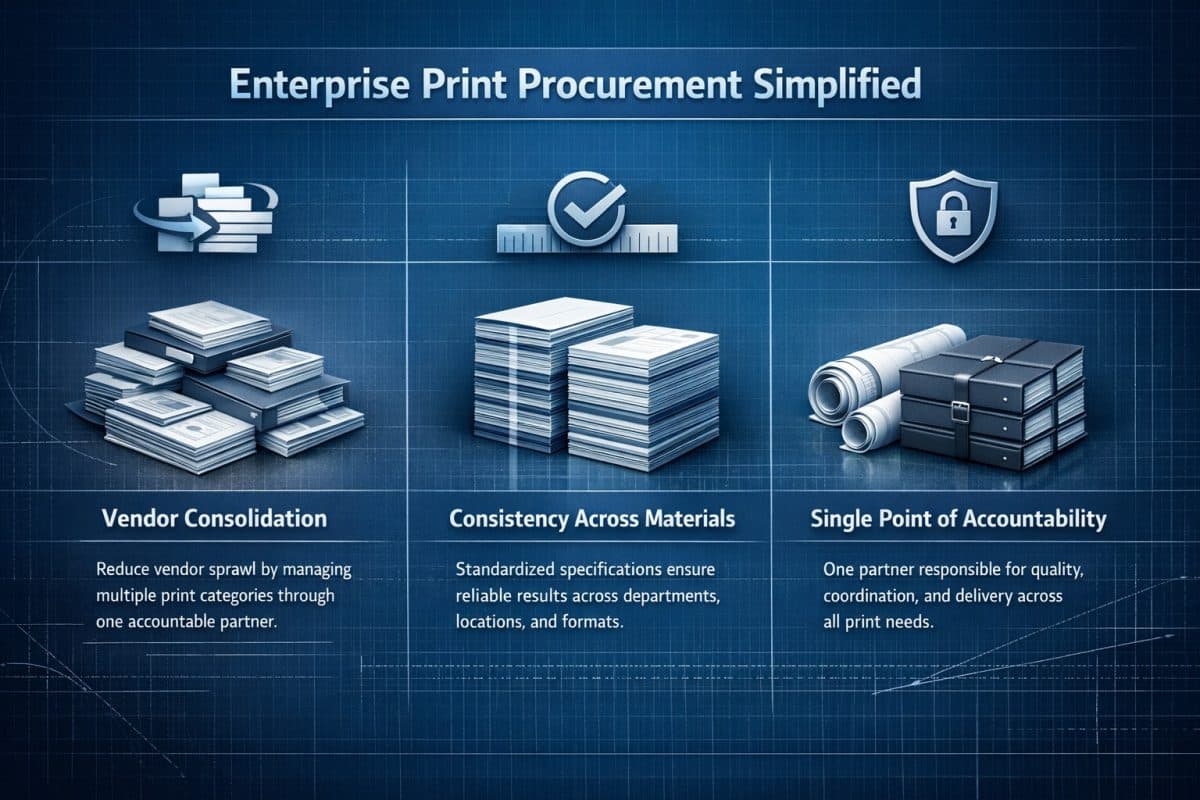
Instead of managing separate vendors for labels, manuals, forms, signage, and documentation, procurement teams gain a single point of contact that oversees specifications, production coordination, quality control, and delivery.
Accountability is clear. Communication is simplified. Standards are maintained across all printed materials.

Maintaining Consistency Across Print Products
Consistency is one of the most overlooked challenges in enterprise print procurement.
When different vendors handle different products, small variations accumulate. Fonts change. Colors drift. Layouts vary. Materials feel inconsistent. Documentation does not align across departments or locations.
For organizations operating across multiple facilities, job sites, or regions, this lack of consistency can cause confusion, reduce professionalism, and even create compliance risks.
CenTex Printing helps address this by managing print specifications holistically. We work from standardized requirements, approved formats, and consistent production guidelines that apply across print categories.
Whether materials are produced in house or through specialized manufacturing partners, consistency is treated as a requirement, not an afterthought.
This allows procurement and operations teams to maintain confidence that printed materials will align with internal standards every time.
Supporting Specialized and Regulated Print Requirements
Many of the industries we serve have print needs beyond standard commercial printing.
Manufacturing and industrial environments require durable equipment labels, safety signage, and operational documentation built for demanding conditions. Financial institutions require secure documents, regulated forms, and controlled production processes. Healthcare organizations rely on accurate, compliant materials used across departments and facilities. Energy, utilities, and infrastructure providers depend on rugged, standardized materials for field use and regulatory compliance.
CenTex Printing supports these requirements through a flexible production model. Some materials are produced in house. Others require specialized processes, formats, or controls that are handled through vetted production partners.
From the customer’s perspective, this distinction does not matter. What matters is that all production is coordinated, managed, and delivered through a single accountable partner.
This approach allows organizations to access specialized capabilities without taking on additional vendor management burden.
Reducing Administrative Overhead for Purchasing Agents
One of the most immediate benefits of consolidated print procurement is the reduction of administrative workload.
Purchasing agents often manage dozens of vendors across categories. Reducing that number, even slightly, can have a measurable impact on efficiency.
With a centralized print partner, procurement teams benefit from:
-
Fewer vendors to manage
-
Simplified purchasing workflows
-
Reduced invoice volume
-
Clear accountability for quality and delivery
-
Faster resolution when changes or issues arise
This does not mean sacrificing flexibility. It means gaining control.
By consolidating print procurement, organizations free internal teams to focus on strategic sourcing, cost management, and operational improvement rather than day to day vendor coordination.
Supporting Multi Location and Enterprise Scale Operations
Many enterprise organizations operate across multiple locations, job sites, or regions. Print needs must scale without becoming chaotic.
Without a centralized approach, materials often vary by location. One site uses outdated forms. Another orders from a different vendor. A third modifies specifications to fit local preferences. Over time, this creates inconsistency and confusion.
CenTex Printing supports multi location organizations by managing print programs designed for repeatability and scale. Standardized specifications, coordinated production, and centralized oversight allow materials to remain consistent regardless of where they are used.
This is especially valuable for organizations undergoing growth, expansion, or organizational change.
Built on Experience, Not Promises
CenTex Printing has supported regional manufacturers, institutions, and enterprise organizations for decades. Many of the print challenges faced by national and multi location organizations are the same challenges we already manage at a regional level.
The difference is scale, not complexity.
By formalizing our approach to consolidated print procurement, we are extending an operating model that has already proven effective for our customers.
This is not about offering every possible product. It is about managing the print categories organizations rely on to function and doing so in a way that reduces friction for procurement teams.
A Practical Approach to Enterprise Print Procurement
For purchasing agents and procurement specialists, the goal is not to find more vendors. The goal is to find fewer, better partners.
A centralized print partner helps organizations reduce vendor complexity, maintain consistency across materials, and simplify internal workflows. It provides clear accountability. It supports compliance. It allows operations to run more smoothly.
CenTex Printing serves organizations that value reliability, consistency, and long term partnership. If your organization relies on printed materials to support manufacturing, operations, compliance, or internal communication, a consolidated print approach can deliver measurable benefits.
Frequently Asked Questions
What types of organizations benefit most from consolidated print procurement?
Organizations with ongoing operational print needs benefit the most. This includes manufacturers, industrial operations, healthcare providers, financial institutions, energy companies, logistics providers, and multi location enterprises.
Does consolidated print procurement limit flexibility?
No. It reduces administrative burden while maintaining access to multiple print formats and production methods. The flexibility remains, but coordination is centralized.
Do all materials have to be produced in house?
No. Production methods vary based on requirements. What matters is that all production is managed through a single accountable partner.
How does this help with consistency across locations?
Standardized specifications and centralized oversight help ensure materials remain consistent regardless of where they are produced or used.
Is this approach suitable for regulated industries?
Yes. In fact, regulated industries often benefit the most from centralized coordination, documentation control, and consistent production standards.
Can this work for organizations with existing vendors?
Yes. Many organizations transition gradually by consolidating print categories over time rather than all at once.




 Business Cards